Categories
Navigating the Anaesthetic Challenges of Greyhounds
Patient: Ralph, 5-year-old male neutered Greyhound, 30 kg
Presenting Complaint:
Ralph was referred to Eastcott Veterinary Referrals to the dentistry and orofacial maxillofacial surgery department for investigation and management of ongoing oral pain and inappropriate oral inflammation.
Pre-Anaesthetic Assessment
A thorough pre-anaesthetic evaluation was carried out by one of our veterinary anaesthesia and analgesia specialists. No abnormalities were detected on physical examination. Pre-anaesthetic bloodwork was also unremarkable. The referring veterinary surgeon had previously reported arrhythmias; however, no such abnormalities were detected immediately prior to anaesthesia by the referring vets or at Eastcott.
First Anaesthetic Event
Ralph was premedicated intravenously with:
- Methadone: 0.3 mg/kg
- Acepromazine: 0.005 mg/kg
- Medetomidine: 0.003 mg/kg
Anaesthesia was induced with alfaxalone to effect. As part of our standard protocol for Greyhounds, Ralph received tranexamic acid (10 mg/kg IV over 20 minutes) prior to starting the dental procedure to reduce the risk of perioperative bleeding. Additional analgesia included intravenous paracetamol and ketamine as part of a multimodal analgesia approach.
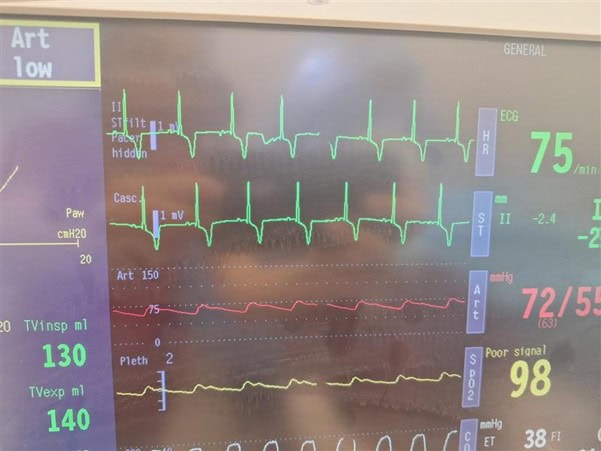
Approximately 90 minutes into anaesthesia, Ralph became hypotensive while maintaining an appropriate heart rate and rhythm on ECG. Ephedrine (0.05 mg/kg IV) was administered to support blood pressure. However, this led to the development of a ventricular arrhythmias. Lidocaine (2 mg/kg IV) was given to treat the arrhythmia, but instead resulted in worsening of the cardiac rhythm.
ECG tracings were reviewed jointly by our anaesthesia, dentistry, and cardiology teams. A venous blood gas analysis with electrolytes revealed:
- Severe hyperkalaemia (K⁺ = 8.2 mmol/L)
- Severe acidaemia (pH 7.15), attributed to respiratory origin
Immediate treatment was initiated:
- Mechanical ventilation
- IV calcium gluconate
- Neutral insulin with dextrose infusion
Ralph returned to sinus rhythm and recovered well post-anaesthesia.
Second Anaesthetic Event (Three Months Later)
Ralph returned for staged dental treatment. Premedication included methadone and medetomidine, with alfaxalone for induction. Blood gas and electrolyte monitoring was conducted throughout the anaesthetic.
One hour into anaesthesia, bloodwork revealed a recurrence of hyperkalaemia, which was managed promptly with:
- Atipamezole
- Neutral insulin
- Glucose infusion
Ralph recovered uneventfully and was discharged once his biochemical parameters normalised.
Anaesthetic Considerations in Greyhounds
Haematological and Biochemical Differences
Greyhounds display several physiological differences compared to other breeds, including:
- Higher haematocrit: typically, 50–60% (vs. 35–55% in other dogs)
- Lower serum albumin
- Higher baseline creatinine, reflective of greater lean muscle mass
These values should be interpreted within breed-specific reference ranges.
Pharmacokinetic Differences
Greyhounds have unique pharmacological responses due to:
- Low body fat content: Affects distribution of lipophilic drugs (e.g., propofol). Reduced fat mass leads to a smaller volume of distribution and prolonged effect of lipophilic drugs.
- Reduced hepatic enzyme activity: Delays metabolism of certain drugs like thiopental, which may last up to five times longer than in other breeds.
- Higher muscle-to-fat ratio: Increases susceptibility to hypothermia under anaesthesia, further impacting drug metabolism and recovery.
Coagulation Disorders
Greyhounds are predisposed to a congenital condition known as hyperfibrinolysis, characterized by:
- Normal platelet count and function
- Normal coagulation times (PT and aPTT)
- Delayed postoperative bleeding due to increased clot fragility and premature clot breakdown
This disorder is reported in up to 26% of Greyhounds. Diagnosis requires thromboelastography (TEG), the only reliable test for this coagulopathy. At Eastcott, prophylactic administration of tranexamic acid is standard in Greyhounds undergoing surgery to mitigate postoperative bleeding risks.
Hyperkalaemia Under Anaesthesia
Hyperkalaemia is a potentially life-threatening complication, more commonly observed in Greyhounds under prolonged anaesthesia. It typically presents after 90 minutes and may be asymptomatic until arrhythmias develop.
ECG findings include:
- Tall, peaked T waves
- Loss or flattening of P waves
- Bradycardia or bradyarrhythmias (including second-degree AV block, Mobitz I)
Differential Diagnoses for Intra-Anaesthetic Hyperkalaemia:
- Iatrogenic (accidental K⁺ administration)
- Tissue injury (e.g., rhabdomyolysis, thermal injury)
- Reduced renal excretion (renal failure, obstruction, uroabdomen)
- Endocrinopathies (e.g., hypoadrenocorticism)
- Respiratory acidaemia (e.g., hypoventilation due to anaesthetic depth)
- Laboratory artefacts (e.g., haemolysis during sample collection)
- Genetic predispositions (greyhounds)
Reported incidence: Up to 38% of Greyhounds under general anaesthesia.
Management of Hyperkalaemia
Goals: Stabilise myocardium, shift potassium intracellularly, enhance excretion
Treatment Protocol:
- Ventilatory support to correct respiratory acidosis and maintain normocapnia
- Isotonic balanced IV fluids: e.g., Hartmann’s solution boluses
- Calcium gluconate: (cardioprotective: stabilization of myocardial membrane)
- Neutral insulin: with concurrent glucose infusion (2.5–5% dextrose)
- Beta-agonists (e.g., terbutaline, adrenaline) if refractory
Conclusion Greyhounds present unique challenges in anaesthetic management due to their distinct physiology, metabolism, and predisposition to specific complications such as hyperfibrinolysis and hyperkalaemia. Careful pre-anaesthetic planning, breed-specific protocols, and intraoperative monitoring are essential to ensure safe and successful outcomes in this breed.